
What is FiSQL?
FiSQL is an idea. Pronounced like 'fiscal', the idea is an accounting system that works for your business. Implement the modules you need. Ignore the modules you don't. Own your data. Customize the system to your needs. Integrate it with the tools you want, or create your own.
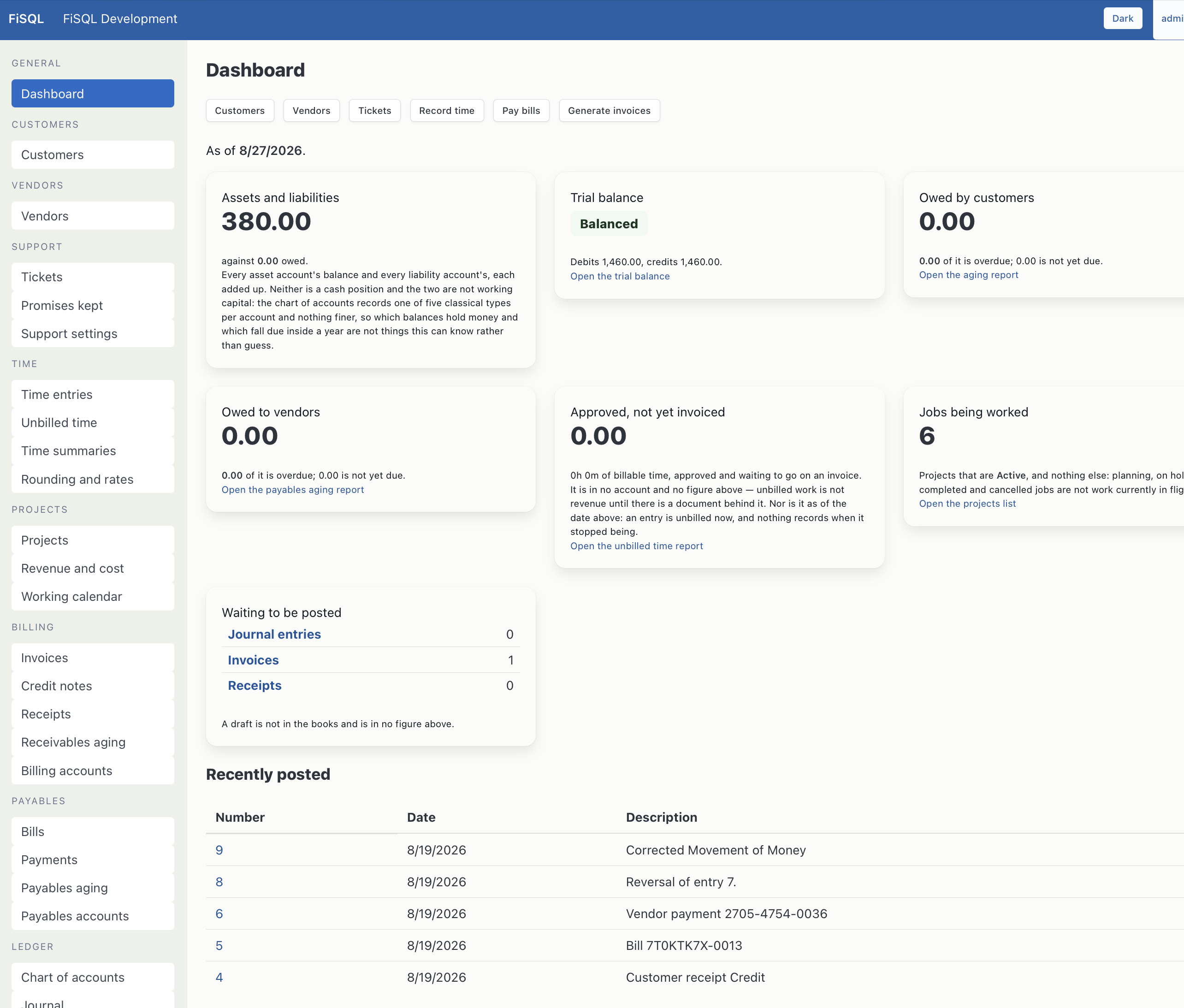
FiSQL is the operating system for a small business: customers, vendors, bills, invoices, the general ledger, projects, time, and support tickets - with stock and warehousing still to come. It runs on a real SQL database you can point any tool at, and it grows one module at a time rather than arriving as a suite you have to swallow whole. The one-sentence version: run your whole business on a database you own.
Why this exists
Most owners looking for something to run the back office find two kinds of answer. Commercial offerings either hit price points too high for a business their size, or feature sets that felt too limiting — locked to one workflow, one integration path, or one vendor's idea of how a bakery, a contractor, or a consultancy ought to keep its books. FiSQL starts from the other direction: an ordinary SQL database, a permission model that scales from one person to a real staff, and modules you turn on as the business actually needs them.
What it actually is
Underneath, FiSQL is a modular monolith: one deployable API, not a constellation of services you have to keep in sync. Backed by PostgreSQL or SQL Server, your choice, both first-class. Multi-tenancy runs on that shared database with strict query filters, so one install can serve every company you keep books for without them ever seeing each other. Access is permission-based rather than role-name based, which means what a person can do is a set of grants, not a job title someone guessed at. Today that foundation carries nine working modules: Identity, Customers, Vendors, Payables, Billing, Ledger, Projects, Time Tracking, and Support. Inventory, warehousing, payroll, and sales are on the roadmap, not on the shelf yet.
Three things follow from that shape:
- Runs where you do. The same container serves a laptop, a machine in the back room, or a cloud platform. Cloud is a deployment choice, not a condition of use.
- Plain SQL underneath. Schema you can read, data you can query, export, and back up without asking anyone's permission but your own.
- Adds up, module by module. Start with customers. Add books when you need books. Nothing you turn on obliges you to turn on the rest.
What it is not
FiSQL is not an all-in-one that only works if you move everything at once. It is not a spreadsheet with a login bolted on. And it is not a hosted service that holds your books hostage to a subscription; the database is yours, and it stays yours whether or not you keep paying anyone. Saying what something isn't is as much a part of the pitch as saying what it is.
Where it stands today
FiSQL is at version 0.1. That is not a figure of speech: this is an early look at working software, not a general-availability launch. The nine modules above run end to end today, with tenancy and permissions proven out across all of them. What isn't built yet — inventory, warehousing, payroll, sales — is stated scope, not a promise of when.
This is a soft announcement on purpose. The right way to look at FiSQL right now is as something worth watching, not something to switch your business onto tomorrow.
It is also a chance for anyone interested to reach out to us with any interest in being early adopters to help shape the future of the platform.